Activity Inspection
We check doors, windows, service penetrations, dark storage areas and likely outdoor harbourage.
Professional Cricket Treatment
Targeted cricket control for homes, shops, offices and commercial premises where persistent chirping, indoor activity or repeated entry is becoming a nuisance.
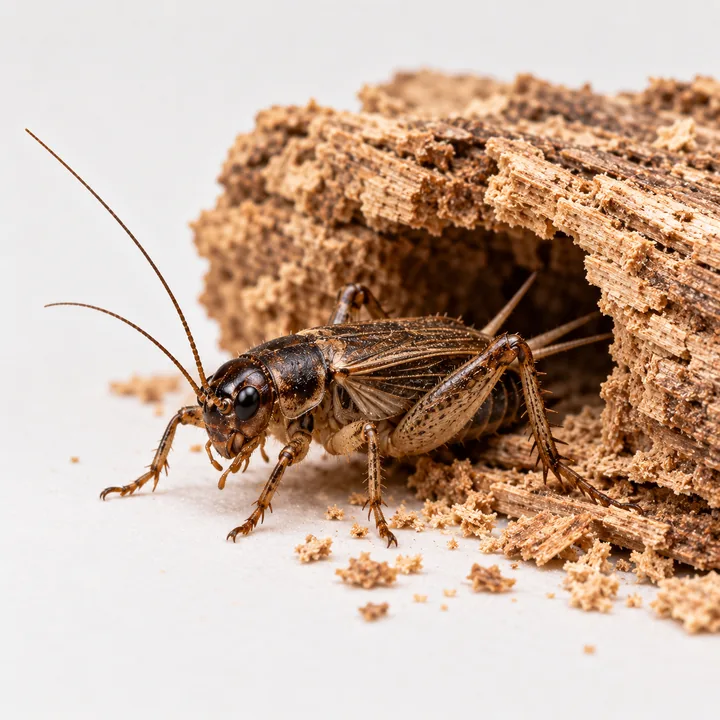
We identify where crickets are entering or harbouring, then combine targeted control with practical prevention.
We check doors, windows, service penetrations, dark storage areas and likely outdoor harbourage.
Treatment is focused on active areas and likely entry routes where appropriate.
We identify moisture, clutter, vegetation and sheltered areas that can support cricket activity.
We recommend practical sealing and maintenance around doors, gaps and service lines.
Crickets often move indoors from surrounding vegetation, damp areas and sheltered exterior spaces. They may enter through gaps under doors, windows and service penetrations, especially where lighting attracts insects near buildings.
Persistent indoor chirping can be disruptive, while some species may damage fabrics, paper or stored materials. Effective control usually combines source reduction, exclusion and targeted treatment.
We focus on where the insects are coming from, not just the ones visible indoors.
Locate indoor activity, entry points and outdoor harbourage.
Address moisture, clutter, vegetation and other conditions supporting activity.
Use targeted control in suitable areas based on the inspection.
Recommend sealing and maintenance to reduce repeated entry.
The method depends on whether the problem is mainly indoors, outdoors or both.
A cricket hidden inside a room, wall void or ceiling can be difficult to locate without inspection.
Repeated entry usually means an exterior source or open access point remains.
Lighting, landscaping and storage conditions can support larger recurring populations.
Long-term control requires reducing both the insects and the conditions bringing them inside.
Removing individual crickets does not stop new insects coming through the same gaps.
We identify access points and pair control with exclusion advice.
Hidden crickets can continue chirping for long periods.
Inspection narrows down harbourage and helps target treatment.
Dense vegetation, moisture and lighting can keep attracting activity near entrances.
We recommend property changes that reduce shelter and attraction around the building.
Source-focused control reduces repeated indoor sightings and chirping.
Entry points are identified instead of ignored.
The plan is adapted to homes, stores, offices and commercial sites.
Lighting, vegetation and moisture issues can be addressed alongside treatment.
Practical answers to common questions before arranging service.
They may be attracted by shelter, warmth, moisture and lighting, then enter through gaps around doors, windows or services.
Many are mainly a nuisance, but some can damage fabrics, paper or stored materials when established indoors.
Not necessarily. If crickets are entering from outdoors, the source and access points also need attention.
Lighting can attract many insects toward buildings, so placement and lighting type may influence activity near entrances.
Reduce harbourage and moisture, manage vegetation near walls, improve screens and door seals, and close obvious gaps.
Get a free quote today and take the first step towards a safer, healthier, pest-free tomorrow.