Detailed Nest Inspection
We trace flight paths and inspect likely nesting points such as eaves, roof voids, wall openings, trees, sheds and sheltered exterior areas.
Professional Wasp & Nest Control
Safe, inspection-led control for active wasp nests around homes, offices, roofs, trees and outdoor areas — without unnecessary disturbance of the colony.
We start by understanding the infestation, then use a targeted plan designed around the property and the pest behaviour.
We trace flight paths and inspect likely nesting points such as eaves, roof voids, wall openings, trees, sheds and sheltered exterior areas.
The treatment approach is selected for the nest location and level of activity, with priority given to controlling the colony safely.
Once activity has been controlled and conditions allow, accessible nest material may be removed to reduce concern and make future monitoring easier.
We advise on sealing practical entry points and monitoring areas where wasps have previously nested.
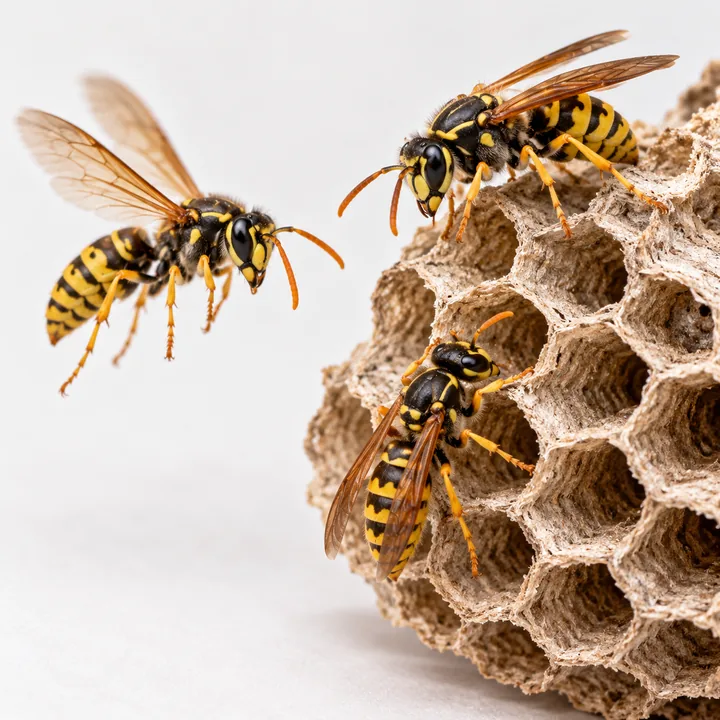
Wasps may build nests in roof spaces, eaves, wall voids, trees, sheds and other sheltered locations. Activity can become especially disruptive when nests are close to doors, paths, patios, work areas or places used by children and pets.
Disturbing an active nest can provoke defensive behaviour and multiple stings. Professional control starts by locating the nest and planning a safe approach rather than simply spraying individual wasps.
A clear four-stage process keeps the work focused and makes follow-up easier to assess.
We observe activity and inspect the property to identify the nest position and access conditions.
We consider nest size, height, access, proximity to people and the safest practical treatment approach.
Targeted treatment is carried out with appropriate protective equipment and techniques for the specific nest location.
We monitor for continuing activity and advise on safe nest removal or exclusion measures where appropriate.
Every property is different. The technician selects methods based on the pest, infestation level, access and how the space is used.
Nests near entrances, patios, schools, work areas or children’s play spaces create a higher sting risk.
Repeated flight into one roof gap, wall opening or tree cavity usually warrants inspection rather than repeated surface spraying.
Where occupants have a known serious allergy to stings, avoid approaching or disturbing the nest and seek professional help promptly.
Good pest control addresses the immediate activity and the conditions allowing it to continue.
An active colony may defend the nest when it is approached or disturbed.
We establish a safer working area, locate the nest and use a targeted control method appropriate to its position.
Roof voids, high eaves and wall cavities can be difficult and unsafe to access without equipment.
The inspection determines access options and whether treatment can be carried out without opening unnecessary parts of the building.
Heavy wasp activity can make patios, gardens, loading areas or customer spaces uncomfortable.
Controlling the source nest restores normal use more effectively than trying to kill individual foraging wasps.
Professional inspection reduces unnecessary disturbance of an active nest.
The service targets the colony source rather than only visible individual wasps.
We assess roof, eave, tree and void locations before deciding on treatment.
Practical exclusion recommendations help reduce future nesting in accessible gaps.
Practical answers to questions customers commonly ask before treatment.
Keep people and pets away from the area, avoid hitting or spraying the nest at close range, and arrange an inspection if the nest is active or near frequently used spaces.
DIY removal can trigger defensive behaviour and multiple stings, particularly with established nests. Professional control is safer when the nest is active, elevated, concealed or close to occupied areas.
Technicians observe flight paths and inspect likely access points such as eaves, roof gaps, wall openings, sheds, trees and voids to locate the source of activity.
Not always immediately. The first priority is controlling active wasps safely. Physical removal depends on accessibility, nest position and whether removal is necessary once activity has stopped.
After the nest is inactive, seal practical access gaps, maintain roof and eave areas, inspect sheds and sheltered structures, and deal with new small nests before they become established.
Get a free quote today and take the first step towards a safer, healthier, pest-free tomorrow.